

Spotting and Avoiding Nightmare Scenarios
When we’re out and about in Japan during our remote work trips, we generally try to find a long-term rental for each month: a centrally located home base and a spot to store our luggage (we shop too much).
Staying in a hotel sounds great for this, except it’s Japan and hotel rooms are so tiny they barely allow you to open your suitcases and will cost you an arm and a leg. Additionally, hotels in Japan charge per person, not per room.
So far, our only real solution is a monthly Airbnb rental. For roughly 30 days, each one runs us about $60 to $100 USD a night, and usually we’re aiming for the high tourism hubs such as Shibuya, Shinjuku, or Ikebukuro.
Aini has had her fair share of budget hotel experiences, so those are unfortunately no longer an option, especially for long-term stays, even if the daily cleaning would be a welcome benefit.
Unfortunately, this places us right into some of the riskiest Airbnb areas we’ve ever seen. Japan’s main hubs like Tokyo are under extreme demand, and people are abusing this need for alternative stays in any way they can.
So, we decided to document and share some tips we’ve gathered from our own experiences on how to spot and avoid these nightmare scenarios:
1. The Location Trap
Airbnb does not give you the exact location of any listing upfront. It picks a vague area on the map and drops a cute little pin that will mislead you into blindly booking a random area in the vicinity, likely 15+ minutes away from where you actually wanted to be.
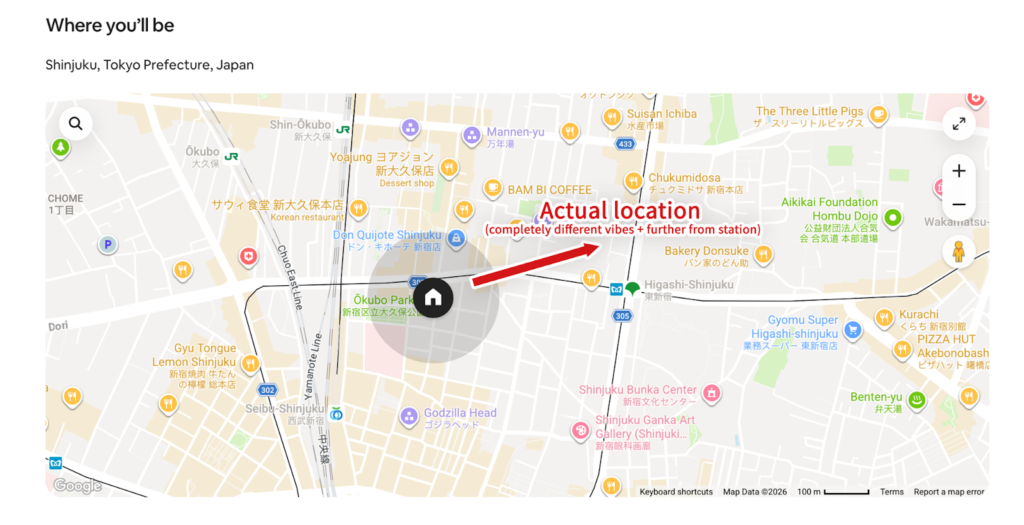
Fortunately, Japan is super strict on long-term rentals and requires hosts to register their location. (This also requires you to provide your passport and sign a short-term lease for them, but we’ll get to that later).
The Registry Workaround: Listings are required by law to include their registered address in the description. You can use this to figure out where the Airbnb is actually located.
Example: We wanted to stay in Kabukicho for perfect access to shopping and nightlife. We looked up the listing code and found it would have put us 10 minutes further away than the pretty little Airbnb pin advertised. Extremely frustrating, but now that we know about the lists, the process has become 100% easier!
There are two types of lists:
Minpaku Registration Certificate (for typical short-term stays) or the Fixed-Term Lease Agreement (often used for stays of 30+ days). These are then sorted by wards. You can google for the ward you are selecting, and then find the list on the ward’s own website; use auto-translate as needed. Search the pdf for the number and obtain the address. If you run into trouble with the Japanese address on Google Maps, you can toss them into a translation software first or just search the address directly via Google. If you mention all of this to an AI like Gemini or Claude, it should be able to assist.
Example List (Used in March 2026):
Shinjuku: https://www.city.shinjuku.lg.jp/content/000447601.pdf
2. Booking Timing & Tactics
You want to book as far in advance as you can, but be aware of some timeline rules:
- Flexible Dates: You can find completely different listings and prices week by week and day by day. Fumble with the +/- days search feature to find the best available stay if you have flexible dates.
- The Early Checkout Hack: If you are looking to stay a little less than a month, book a full month’s stay (which is often cheaper) and check out ahead of time. Just don’t expect to get your unused days refunded. Prices vary extremely between 2–3 week stays and long-term ones. Plus, 30-day minimum locations are generally better equipped. You can then cite personal reasons for the early checkout. For the key handover just arrange this with your host, but most places we’ve stayed have a way to check out online.
- The Compensation Cutoff: If you are more than 2 months out from your booking, there’s a rule that Airbnb agents cannot provide you additional compensation for issues. Say you were diligent and booked months in advance, and 3 months out your host decides to screw you over? You will be out of other booking options and better pricing and return to the hunt.
3. Decoding Listing Details
Do not just rely on Airbnb’s filters and descriptions (or lack thereof). Ensure you scan absolutely every avenue for possible hidden details and ready yourself for a treasure hunt or you may pay the price for your negligence.
First decide on which amenities you absolutely need, and which you can survive without, then keep those in mind when you filter and scan the descriptions, photos and reviews!
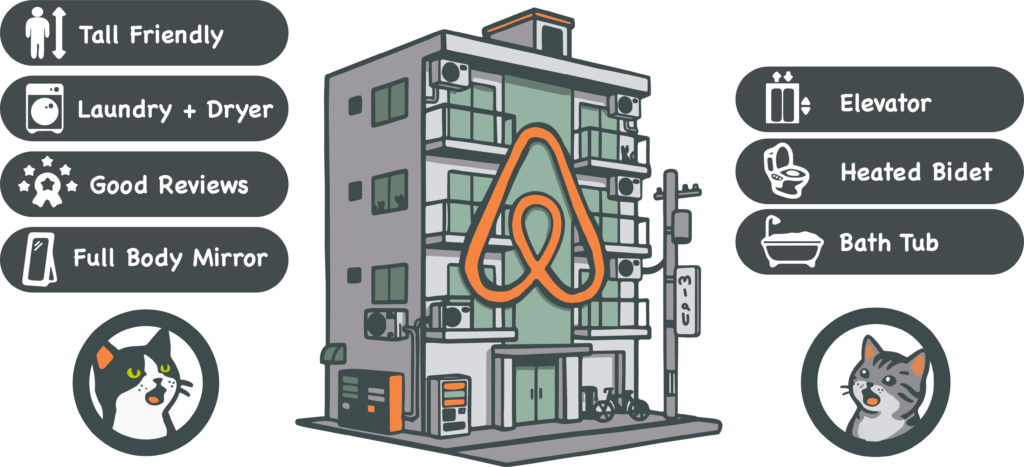
We’ve got some very specific requirements of our own…
- Hidden Missing Amenities: Elevators are not listed under amenities. We’ve seen “No elevator” notices buried only in photos or mentioned reviews, so always hunt for that info.
- Climate Control: Know what time of year you are staying. In the Japanese summer or winter, scan the amenities specifically for AC and Heating. If they don’t have them, you may have an awful time.
- False Categories: Some rooms are falsely categorized. We’ve seen shared-restroom listings listed under “whole home rentals,” and private space filters don’t always include condos.
- Wide-Angle Trick Shots: Camera magic can make the tiniest space look roomy. Use all the images to figure out a floor plan and never assume there’s additional space. If you don’t physically spot a room to open a suitcase, it’s not there. Orient yourself by doors, windows, and kitchens. We’ve seen lots of listings without square meter/foot measurements, and given it’s Tokyo, it’ll be small.
- Height Warnings: If you are tall, scan the listing and reviews for height descriptions. We’ve seen reviews mention 180 cm max-height showers. Knowing this may save you a bruise or two.
- Strict No-Refund Policies: This is shady unless you are booking very close to your dates. If anything goes wrong, you will have to rely entirely on an Airbnb agent’s intervention.
4. Spotting Gamed Reviews
Hosts in these areas are constantly gaming the review system.
- The Fake Host: See a host of 3 years, but zero reviews on the specific unit you’re looking at (and it isn’t marked as “New”)? Shady.
We stayed in one of these and it had massive mold issues. We had to quarantine one whole room off, and since it was booked on a fresh Airbnb account, we simply PTSD’d out and never looked back instead of fighting through reviews. We did notice other listings in the same building had problems in the reviews. These are now long gone too, though - Missing Badges: If a listing is supposedly new but lacks a “New” flag, it’s likely a gamed listing. Always compare the host’s total time on the platform to their number of reviews.
- Timeline Gaps: Check the stay dates on reviews. Long gaps between stays can be suspicious. Compare an advertised Superhost’s review numbers against suspicious hosts, and you’ll quickly spot the black sheep.
- Follow the Fixes: If you see a really bad review about a specific issue, follow the subsequent dates to see if it actually got fixed or if it’s ongoing.
- Check Google Maps: If you use the registry trick to find the actual address, look it up on Google Maps too. We’ve occasionally found reviews for the Airbnb left directly on Google.
5.1 Spotting Odd Hosts & Co-Hosts
Take note of who you are renting from. The same host may use different accounts (under different names/languages or with the same profile picture) to continue gaming the review system.
Some tips on how to spot bad eggs:
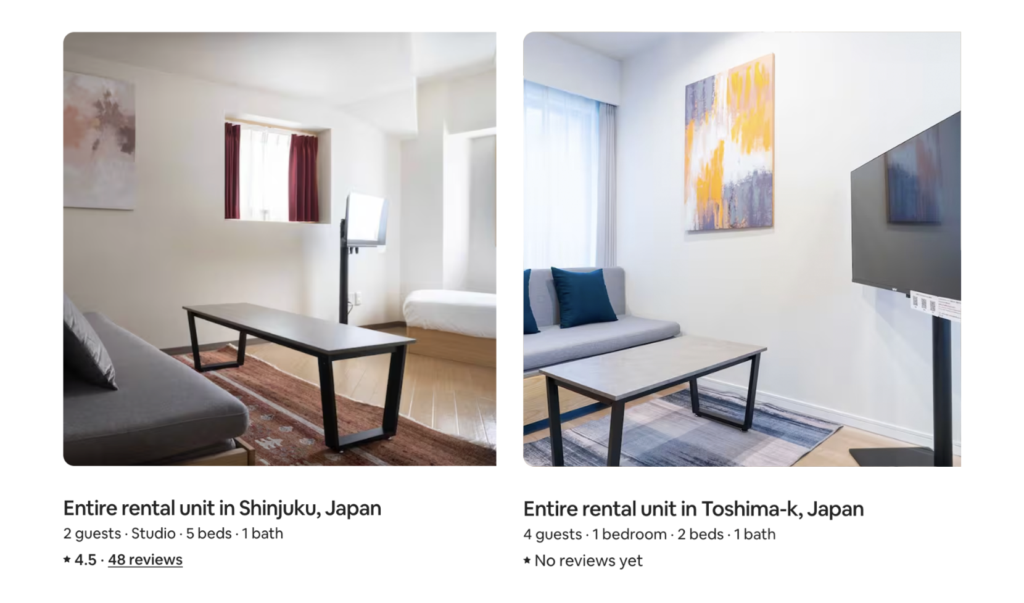
Aside from the fact that these are in completely different wards, note how the right one has zero reviews as well. That’s the one we stayed in about half a year ago, it had a bedroom plagued with mold.
- The Furniture Clone: The shady host from our mold experience equips every Airbnb with the exact same style of furniture. If I spy a particular minimalism black metal and wood furniture aesthetic, the same TV, and the same beds, all the alarms go off.
- Co-Host Shields: We’ve noticed Co-Hosts taking over conversations during scammy bookings. The actual host account might send a single message and disappear. My guess is that if they get hit with repercussions, the Co-Host account takes the blame, leaving the main one untarnished.
- Nationality Check: Our experience shows that local hosts from Japan know the (countless) complex laws, hospitality customs, and area details way better than outsiders. I personally look for hosts who have multiple properties and rent out their unused ones. Even better is when they rent out their old home. Because they actually lived there and roamed the area themselves, they know it inside out and usually have awesome Airbnb guides for local hidden gems.
Based on my experiences so far, should I notice specific foreign languages on their “spoken languages” lineup, I might think twice about booking with them!

5.2 Spotting Great Hosts
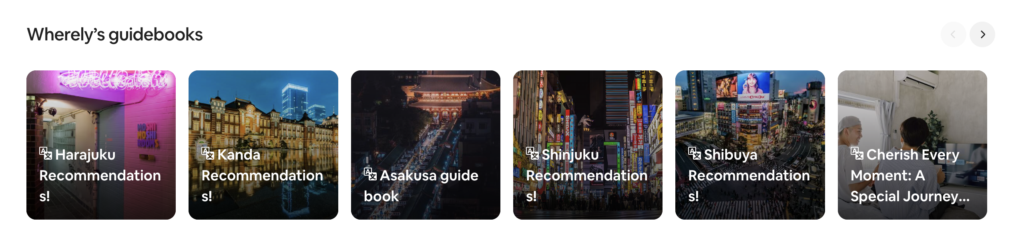
Hosts that rent out their old homes sometimes have really cool guides for local hidden gems that you can view on Airbnb!
Experienced Hosts: Some hosts go the extra mile. Aside from the guides shown, this one had a detailed video guide just for the trash and recycling. This is huge because Japanese garbage sorting is notoriously difficult to grasp, and every neighborhood has super picky laws. You can’t just toss things out! Some areas require you to wash out all cans, bottles, and food containers, plus separate the caps and labels from plastic bottles into different bags. Combine that with strict pickup schedules (like burnables on Tuesdays, plastics on Wednesdays), and having a local break it down is an absolute lifesaver, especially when the trash disposal location is super hidden and again, all the different sections for each type are labeled in only Japanese. You can expect each Airbnb you book in Japan to have a separate nifty and detailed guide for the trash.
6. Scam Galore
If you rent for 30+ days, you (and anyone accompanying you) must provide your passport and sign a “Fixed-term Lease Agreement.”
- Communication Blindspot: This opens you up to vulnerabilities, since they have to send you the document, but Airbnb blocks file sharing outside of photos, so no .pdf to sign.
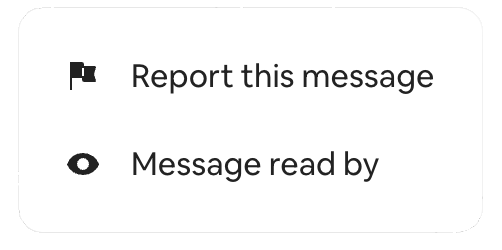
We’ve had to do some in-person signing, used automated platforms, or used emails so far. During one email exchange, the host tried to offer us a direct booking outside of Airbnb who turned out to be a scammer (learned a lot from that one!). Be aware you are handing over your PII (Personally Identifiable Information) to these people. Again, if anything happens, try to move communications right back to Airbnb and use the Report this Message feature on the message that asks you for the outside communication. It will open up support, where you should attach screenshots of any red flag messages. (For us it was a request to pay in cash outside the Airbnb platform and for us to cancel a non-refundable booking)
7. Support & Documentation
After running into bad experiences and researching tips, we’ve stepped up our own documentation game, and we recommend the following for peace of mind:
- Film the Walkthrough: When you arrive, do a walkthrough and film it immediately.
- Keep it on the App: Anything off? Document it and message your host (and Airbnb support if needed) right away. Always communicate over the Airbnb chat. Even if it’s messy, having a documented paper trail is your top priority.
- Never Cancel First: If you have issues, never initiate a cancellation yourself without contacting Airbnb customer support first. No matter the issue, you want things documented and sorted out by them. You are paying hefty fees to be protected by Airbnb, so make sure you use it, even if it is stressful.
- Support quality depends on timing: if you are physically at the Airbnb having issues, support is usually better and faster. If your booking is far out, expect broken English and false instructions. It’s a bit of a mess.
- Support Tiers Vary: The quality of support you will receive is a mixed bag. Generally an agent is assigned to you and they are at a specific tier, (sometimes they will tell you which tier they are) and this specifies what they are allowed to do in your case. You may need to exhaust the lower-tier support agent before escalating to a superior agent (which seems to only happen via phone calls) who generally has more options in terms of taking actions such as a cancellation or refund/compensation.
8. Build Your Own Profile
Every time you complete a stay, you get rated by your host as well.
- Add Your Guests: Make sure anyone staying with you is on the itinerary and has their own Airbnb account so they build history too. (Messages will be viewable by everyone, and connections are documented in your profile).
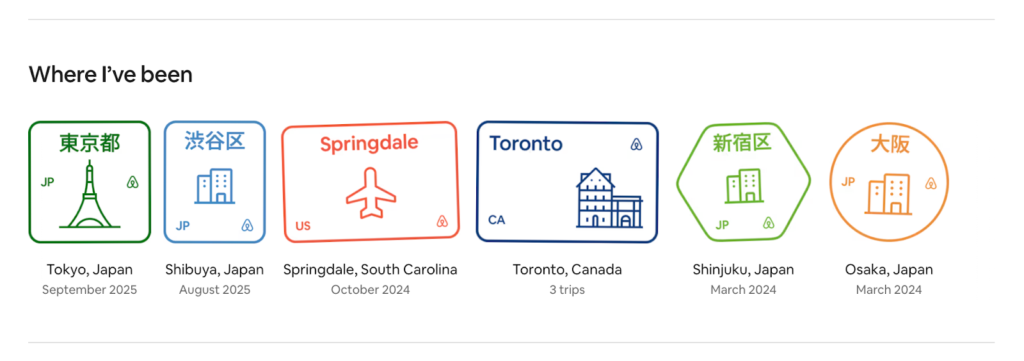
- Booking Success: Accounts with solid booking histories have better success securing rentals because it shows hosts you are a trustworthy guest. Plus, the little stamps they show on your account are super cute!
That’s about all we’ve gathered so far in April 2026, we’ll be sure to add any new things we come across (hopefully not, because they are mostly based on bad experiences…)